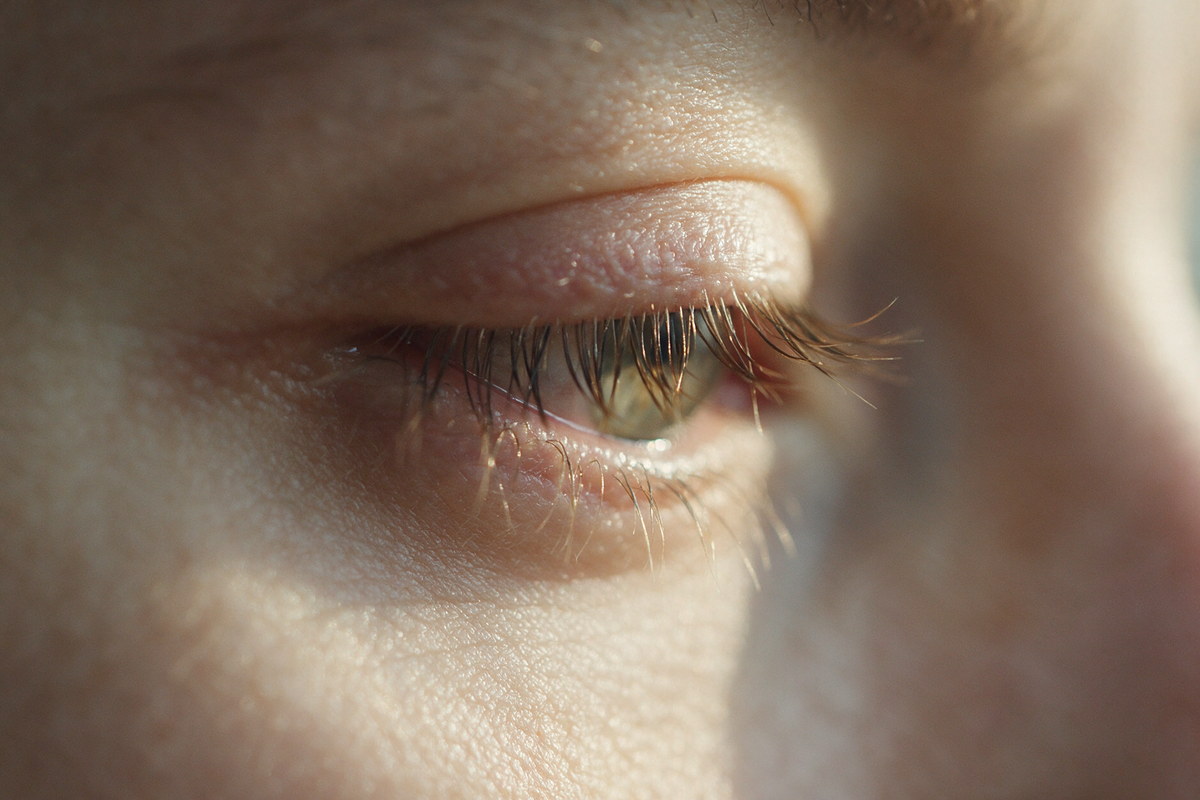
"Why is my eyelid twitching?" is a question I hear nearly every week, often from people who have been watching their lid flutter for days and have started to wonder whether something is wrong. In most cases nothing is. A twitch is a small, involuntary contraction of the muscle that closes the lid, and it usually settles by itself. This article explains what an eyelid twitch is, the triggers I see most often, how upper and lower lid twitching differ, the link with dry eye, the rarer situations in which a twitch is not benign, what helps at home and when to see an eye doctor.
The medical name for the ordinary eyelid twitch is myokymia. A few muscle fibres in the orbicularis oculi, the ring-shaped muscle that closes the eyelids, fire on their own for a short time. You feel a fine flutter or pulse, usually in one eye. Other people almost never notice it, even when it feels obvious to you. A twitch may last a few seconds or come and go over several days, and in some people it lasts a couple of weeks before it fades.
The muscle is not damaged and the eye itself is healthy. Myokymia is a nuisance rather than a disease, and no test is needed when it is brief, painless and limited to one lid.
Nobody can point to a single cause, but the triggers are consistent. The ones patients mention most are short or broken sleep, a heavy run of coffee or tea, long hours at a screen with little blinking, emotional stress and general physical tiredness. Alcohol and a heavy week of eye strain from reading in poor light come up as well. Often two or three of these overlap, which is why the twitch tends to appear in exam periods, during a deadline or after a bad night.
Screen work deserves a note. When we concentrate on a screen we blink less and the tear film thins, so the lid margin works harder and the eye feels tired. The twitch is the muscle's way of showing that load. Knowing that the twitch comes from a tired, overworked muscle usually reassures people that nothing structural is happening.
A lower lid twitch is by far the most common version, and it is also the one people worry about least once they understand it. An upper lid twitch is felt more strongly because the upper lid moves more, and it can make the vision seem to flicker for a moment. Neither location points to a particular disease. What matters is not which lid is involved but whether the movement stays confined to a small area, whether it comes in short bursts and whether anything else changes around it.
A twitch that stays on one side and lasts a few days is typical. A twitch that regularly spreads to the cheek or the corner of the mouth, or that repeats for weeks without a break, is different and is worth an examination.
Dry eye and eyelid twitching often travel together. When the tear film is unstable, the eye stings, burns or feels gritty, and the lids work harder to spread tears. In patients who describe a twitch along with a tired, sandy feeling, I look at the surface of the eye and the lid margins before looking for anything else. Treating the dryness frequently quiets the twitch as well. If you recognise this picture, our page on dry eye disease explains how the condition is assessed and managed, and the page on eyelid diseases gives an overview of the lid conditions that can add to irritation.
A small number of twitches are the first sign of something different. Blepharospasm is a condition in which both eyelids start to close involuntarily, in spasms that get stronger and more frequent over months. At first it may look like ordinary twitching, but the lids begin to squeeze shut, light becomes uncomfortable and daily tasks such as reading or driving become difficult. It needs a specialist assessment and ongoing care.
Another pattern is hemifacial spasm, in which one side of the face, including the eyelid, contracts repeatedly. Here the facial nerve is irritated, often by a nearby blood vessel, and the twitching spreads from the eyelid to the cheek and mouth on the same side. A twitch after a period of facial weakness is a separate situation, because the recovery of the facial nerve can leave unwanted movement behind. If you have a history of facial weakness, our article on facial paralysis and its effects on the eyes covers what to expect.
Occasionally a twitch begins after a new medicine or alongside other neurological symptoms. That is a reason to speak with your doctor rather than wait it out.
For an ordinary twitch the useful measures are modest and sensible:
Rubbing the eye makes irritation worse, so it is better to avoid it. A twitch rarely responds to a single change overnight; most settle once the tiredness or caffeine load falls.
A brief, painless twitch that comes and goes does not need an appointment. Please arrange an examination if:
Sudden facial weakness, double vision or severe eye pain with a twitch should be assessed the same day. Otherwise, an eye examination will check the surface of the eye, the lids and the muscles and will usually settle the question quickly.
Short sleep, caffeine, long screen time and stress are the usual reasons. Dry eye can add to it. Most twitches fade once these triggers are reduced. If one lasts more than two to three weeks, an eye examination is sensible.
Usually not. The common type, called myokymia, is a harmless flutter of a small muscle. It is a reason to see a doctor only when it spreads to the face, closes the eye or lasts for weeks.
Lower lid twitching is more common and is usually related to tiredness. Upper lid twitching is felt more strongly because that lid moves more. Neither position points to a specific disease on its own.
A single episode lasts seconds to minutes, but it can return on and off for several days. Some people have it for two weeks or so. Persistence beyond that, or a worsening pattern, should be examined.
Sleep, less caffeine, regular screen breaks, a warm compress and preservative-free artificial tears for dry eyes are sensible first steps. There is no instant fix, and it usually fades as the trigger lessens.
Yes, it can contribute. An unstable tear film irritates the eye surface and the lids work harder, which can show as a twitch. Treating the dry eye often helps the twitching settle too.
When it spreads to the cheek or mouth, makes the eyelid squeeze shut, affects both eyes or comes with facial weakness. These patterns can be blepharospasm or a facial nerve issue and need medical assessment.
 English
