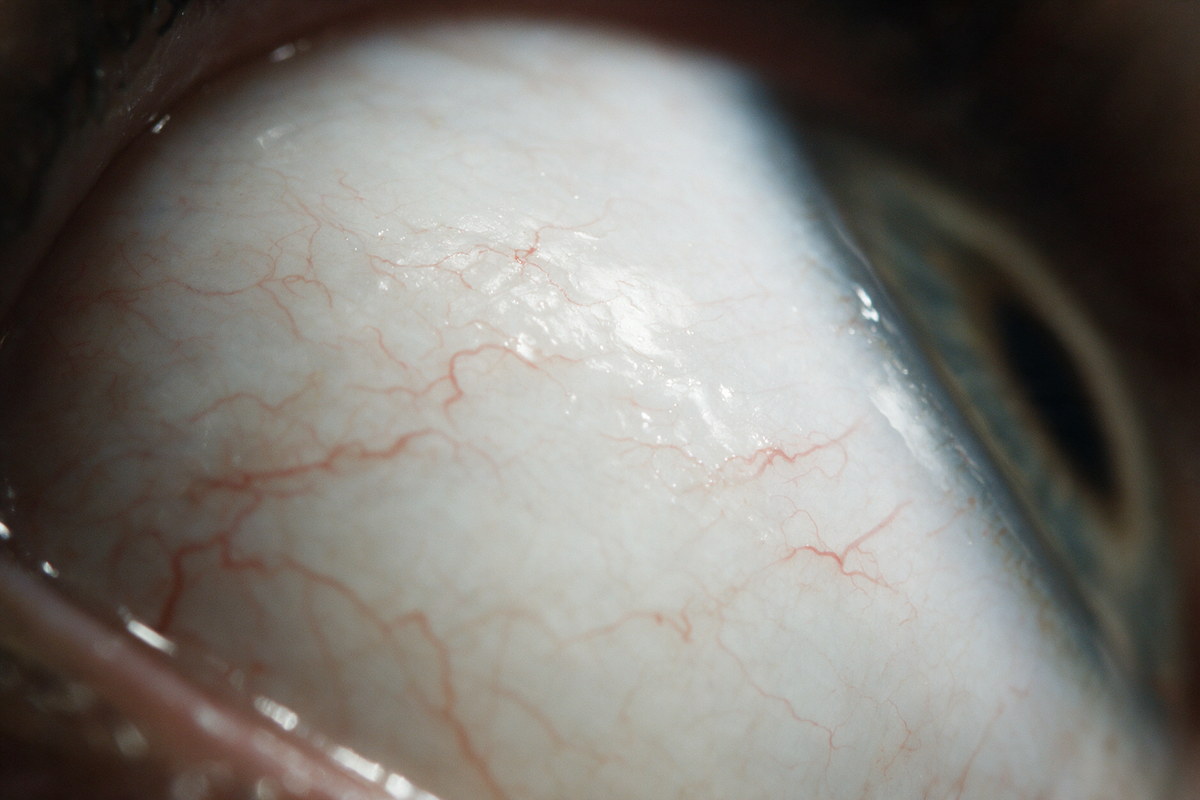
Patients often come in with the same words: "There is a little yellow bump on the white of my eye, and it has been there for months." In many cases it is a pinguecula. Sometimes it is a pterygium, which is a different and less common growth. This article explains what a pinguecula is, how to tell it apart from a pterygium, why sun, wind and dust are the usual triggers, why the area can turn red and irritated, whether it can grow onto the cornea, what helps and what does not, when surgery is considered and when to see an eye doctor.
A pinguecula is a small, raised, yellowish or whitish patch on the conjunctiva, the thin clear tissue that covers the white of the eye. It most often sits on the side nearest the nose, though it can also appear on the outer side. The tissue underneath has changed with long exposure to irritants. The word comes from the Latin for fat, because early observers thought the patch looked fatty. It is not fat and it is not a tumour.
It is common, it becomes more frequent with age, and most people with one have no symptoms apart from the look of it. Because it is usually harmless, no treatment is needed when it does not bother you.
Both grow from the same kind of tissue, but they behave differently. A pinguecula stays on the white of the eye and stops at the edge of the cornea. A pterygium is a wing-shaped growth that crosses that edge and spreads over the clear surface of the cornea toward the pupil. A pterygium often carries visible blood vessels and, if it grows far enough, can change the shape of the cornea and blur vision.
A pinguecula is not a pterygium waiting to happen, but they share the same risk factors, and having one tells me the eye has had plenty of exposure. Our page on pterygium explains that condition in more detail. Because other surface lesions can look similar, any unusual patch should be looked at under the microscope at the slit lamp rather than guessed at from a mirror.
Ultraviolet light is the best-known factor. Wind, dust, dry air and long years outdoors add to it, and the pattern is familiar among people who work or spend leisure time in bright, open settings. That is why the old nickname "surfer's eye" exists. A lack of eye protection and a dry eye surface make the problem more likely, since the conjunctiva loses some of its natural lubrication and protection.
Smoke, chemical vapours and welding glare can contribute too. Wearing sunglasses that block ultraviolet light and a hat on bright days is a sensible habit, although it cannot promise that a pinguecula will never form.
Most of the time a pinguecula sits quietly. Sometimes it becomes inflamed, a state called pingueculitis. The patch turns red, feels gritty or burns, and the eye may water. This happens because the raised area disturbs the tear film and dries out more easily, especially in wind, air conditioning or after a long time at a screen.
The redness is usually limited to the area around the bump, and vision stays clear. Redness that spreads over the whole eye, with pain, strong light sensitivity or blurred vision, is a different picture and needs prompt assessment. Our page on dry eye disease describes the surface problems that often make a pinguecula flare.
No. By definition, a pinguecula does not cross onto the cornea. If a growth does reach the clear surface, that is a pterygium, and it is monitored in a different way. A pinguecula can slowly enlarge over the years or change colour, but it should not suddenly grow, bleed or look different within a few weeks. Rapid change, a hard or pigmented patch, or a lesion that bleeds easily calls for examination, because conjunctival growths of other types exist. You can read more about them on our page on tumours of the eye surface and conjunctiva.
When a pinguecula is irritated, the aim is to calm the surface. Preservative-free artificial tears keep the area moist and reduce friction. Avoiding wind and smoke, resting from screens and wearing sunglasses outdoors all help. A short course of a prescribed anti-inflammatory drop is sometimes used when the area is clearly inflamed, but that is your doctor's decision after an examination.
What does not help is hunting for a whitening drop. Drops that make the eye look white by narrowing blood vessels give only a brief effect and can cause redness to rebound once they wear off. Scraping, home remedies and rubbing the eye make the surface worse. A pinguecula does not dissolve with drops.
Most pinguecula never need surgery. The operation is considered when the bump keeps becoming inflamed despite proper care, when it interferes with contact lens wear or the tear film so that the eye is repeatedly uncomfortable, or when it is bothersome for cosmetic reasons and the patient wants it removed. The decision is individual. Recurrence is possible, and the surgeon will explain the aims and limits of the procedure before any decision is made.
A stable, painless patch does not need urgent attention. Please arrange an examination if:
Severe pain, strong light sensitivity or a sudden drop in vision with a red eye should be assessed the same day.
A pinguecula is a harmless yellowish or whitish raised patch on the conjunctiva of the white of the eye, usually beside the nose. It develops after long exposure to sun, wind and dust and is common with age.
A pinguecula stays on the white of the eye. A pterygium is a wing-shaped growth that crosses the edge of the cornea and can spread toward the pupil, sometimes affecting vision. Only an examination can separate them reliably.
It usually does not disappear by itself. It may stay the same for years. When it is irritated the redness settles with proper care, but the patch itself remains unless it is surgically removed.
It is not a direct step, but both share the same triggers. Having a pinguecula shows that the eye surface has had heavy exposure, which is also the setting in which a pterygium can develop.
Inflammation of the patch, called pingueculitis, makes it red and gritty. Wind, dry air, screens and dry eye often set it off. Persistent redness, pain or blurred vision should be examined.
Lubricating drops soothe irritation, and a doctor may prescribe a short anti-inflammatory course when it flares. No drop removes the patch itself, and whitening drops can cause rebound redness.
Rarely. It is considered when the bump is repeatedly inflamed despite care, interferes with contact lens wear or comfort, or bothers the patient cosmetically. Recurrence is possible, so the decision is made after examination.
 English
