
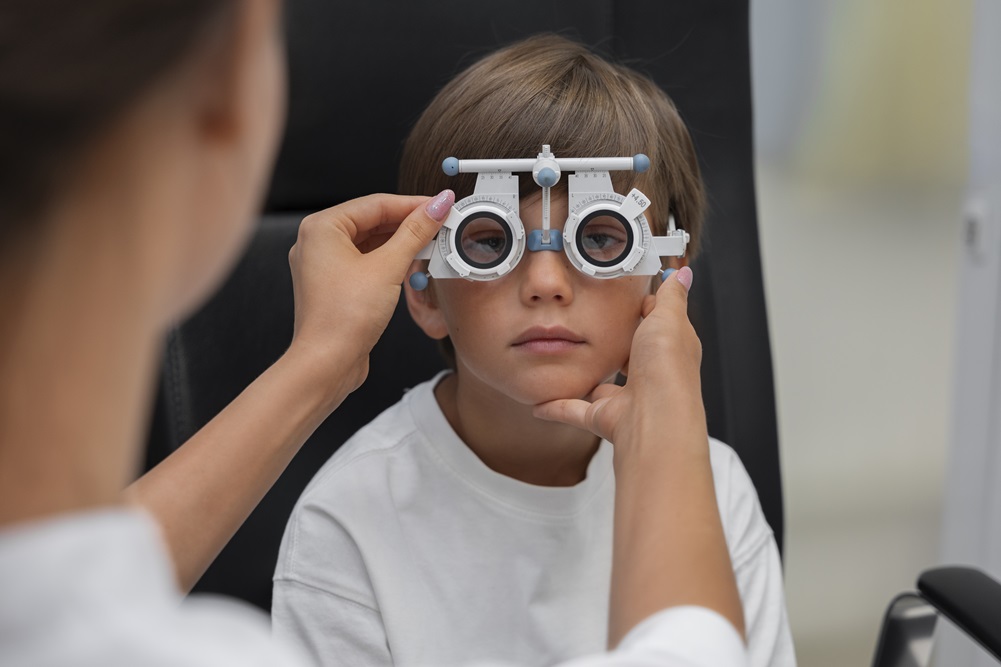
Myopia is a refractive error that causes distant objects to appear blurry. It occurs when the eye is longer than average from front to back, or when the cornea and lens are too refractive, so light focuses in front of the retina. Near vision stays clear while distance vision blurs. The typical picture is a child who cannot read the classroom board, moves closer to the television and screws up the eyes at distance, yet reads a book comfortably.
Myopia usually begins at school age and can increase throughout growth. That increase is not merely a change in the prescription; it means the eye is growing longer. For this reason I have two separate aims in childhood myopia: to make today's vision clear, and to try to slow the rate at which the prescription progresses.
A sudden drop in school performance or apparent inattention is sometimes simply an inability to see the board, which is why school-age vision screening matters.
No method reverses myopia today, but several approaches can influence how fast it progresses. They are planned together according to the child's age and the yearly rate of increase:
High myopia carries adult-life risks including retinal tears, retinal detachment, earlier cataract and glaucoma. That is why slowing progression in childhood matters.
Early diagnosis and treatment of myopia protects the child's vision and supports school life. Myopia often coexists with astigmatism; see astigmatism in children. Other topics are listed under pediatric eye diseases.
As an Ophthalmologist, Dr. Ayşe Dolar Bilge, I provide diagnosis and treatment services with my experienced team.
Childhood myopia usually increases during growth because the eye keeps getting longer. No method reverses it today, but several approaches can influence the rate of progression: increasing daily outdoor time, considering low-dose atropine or orthokeratology in suitable cases, and measuring the yearly change at regular follow-up.
Difficulty seeing the board is the classic sign of myopia, but it does not confirm the diagnosis on its own. Astigmatism, amblyopia or another problem can produce the same picture. A full examination with cycloplegic refraction makes the distinction.
Heredity is the strongest determinant of myopia, but prolonged uninterrupted near work is thought to contribute to progression. My emphasis is not on banning screens but on increasing daily outdoor time, keeping a reasonable working distance and taking regular breaks.
No. A correct prescription does not increase myopia; it simply provides clear vision. Deliberate under-correction does not slow progression either and leaves the child straining with blurred vision. The increase relates to the growth of the eye, not to the glasses.
As the eye lengthens in high myopia the retina thins, which raises the adult-life risk of retinal tears and detachment, earlier cataract and glaucoma. For this reason fundus examination and intraocular pressure measurement are a fixed part of follow-up in children with high myopia.
Sudden blurring, marked loss of vision in one eye, flashes of light, a sudden increase in floaters or a curtain across the visual field require urgent assessment. In children with high myopia these complaints may involve the retina and should not wait.
To get detailed information, send us your contact information and we will call you as soon as possible. Contact us now
 English
