Birgen Business Center, Bağdat Ave. No 226, Floor 2, Unit 10, Kadıköy, Istanbul, Turkey
+90 553 910 91 39 info@aysedolarbilge.com
Contact Us WHATSAPP
Get Information Now
Please enter a valid name.
Lütfen geçerli bir Email adresi giriniz.
Please enter a valid phone number.
Hyperopia is a refractive error in which light focuses behind the retina. Children can read the chart normally yet struggle with near work, develop headaches or show an inward turning eye. Cycloplegic refraction reveals the true degree, and the right glasses prevent esotropia and amblyopia.
Child with glasses for hyperopia reading a book

What Is Hyperopia in Children?

Hyperopia, commonly known as farsightedness, is a refractive error in which light focuses behind the retina rather than on it. It occurs when the eyeball is shorter than average or when the cornea and lens are not refractive enough. To see clearly, the child constantly engages the focusing muscle inside the eye, a process called accommodation.

This is where children differ sharply from adults. A child's focusing power is strong, so a hyperopic child may read the chart perfectly. Because visual acuity looks normal, the problem is easily missed, while the eyes have been working hard all day. Headaches, fatigue during reading, reluctance to do near work and, in some children, an inward turning of one eye are the consequences of that effort.

Causes of Hyperopia in Children

Developmental and Genetic Causes

A family history of hyperopia or other refractive errors.

Shorter-than-normal eyeball length.

A flatter cornea or lens with insufficient refractive power.

Birth History

Incomplete eye development in preterm infants.

Low birth weight or developmental delay, both of which make me examine the child more often.

Hyperopia That Is Normal for Age

Most children are born mildly hyperopic. As the eye grows, its axial length increases and this physiological hyperopia decreases towards school age. Low degrees found in young children therefore often need observation rather than glasses. The decision rests on how far the degree exceeds what is expected for the age, the difference between the two eyes, whether any deviation is present, and the child's symptoms.

Symptoms of Hyperopia in Children

Difficulty Seeing Nearby Objects: Blurred vision when reading or engaging in close-up tasks.

Eye Strain: Discomfort or fatigue following prolonged near work.

Headaches: Often across the forehead and more noticeable towards the end of the day.

Squinting: Attempting to see more clearly by narrowing the eyes.

Sensitivity to Light: Discomfort in bright light settings.

Avoiding near work: Losing interest quickly in books, colouring or puzzles; restlessness during homework.

Inward deviation of an eye, particularly when looking at something close.

Frequent eye rubbing and watering.

Hyperopia and Accommodative Esotropia

This is the most important childhood consequence of hyperopia. As the child forces the focusing muscle, the system that turns the eyes inward is engaged at the same time, and one or both eyes may deviate inward. This is called accommodative esotropia.

The deviation may first be noticed only during near work, when the child is tired or after an illness.

With the correct prescription the need to accommodate disappears, and the deviation may improve substantially or resolve completely.

If a deviation persists despite glasses, assessment continues under strabismus in children.

Diagnosis of Hyperopia in Children

Comprehensive Eye Exam: The child's overall vision and eye health are assessed.

Refraction Test: Measures the degree of refractive error and the need for corrective lenses.

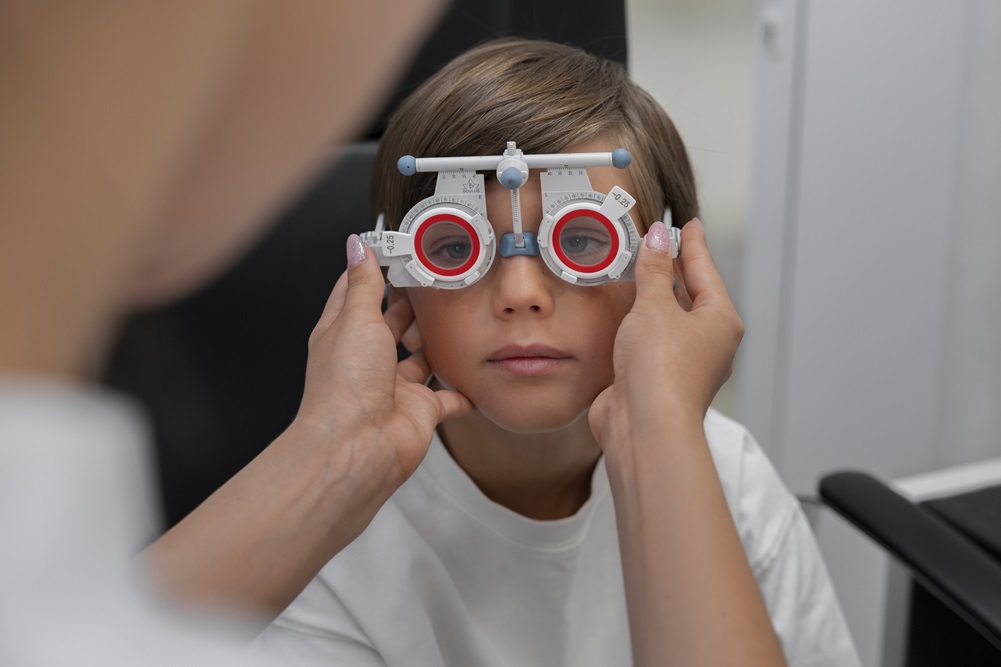
Cycloplegic Refraction: Eye drops relax the focusing muscles so the true degree can be measured. This step is essential in hyperopia; without it the strong focusing muscle hides the prescription.

Ocular Alignment and Binocular Function: Measured separately for distance and near.

Amblyopia Assessment: The best visual acuity achievable with correction is determined.

Fundus Examination: The optic nerve and retina are evaluated.

After cycloplegic drops the pupils stay large for a few hours, near vision is blurred and bright light is uncomfortable. Sunglasses or a hat on the day of the examination help, and it is better not to schedule the visit on a demanding school day.

Treatment Options for Hyperopia in Children

Eyeglasses

The most common and effective treatment for hyperopia.

Convex lenses redirect light for proper retinal focus.

When accommodative esotropia is present, glasses must be worn full time; the deviation returns when they are left off.

The prescription changes with growth, so it is reviewed at regular follow-up visits.

Contact Lenses

An alternative for older children who opt not to wear glasses.

Requires strict hygiene and parental supervision.

Patching for Amblyopia

When the two eyes differ in degree, the less hyperopic eye sees more clearly and the other may fall behind.

Covering the stronger eye for defined periods exercises the visual pathways of the weaker eye.

Patching hours depend on age and on the difference in acuity, and are revised at each visit.

Orthokeratology and Laser Surgery

Overnight rigid lenses reshape the cornea temporarily; suitability in hyperopia is limited and depends on corneal measurements.

Laser surgery is generally reserved for adults, once the prescription is stable.

Amblyopia Risk and Screening Schedule

Newborn period: Red reflex examination.

6-12 months: First ophthalmic examination when there is a family history of refractive error, strabismus or amblyopia, or a history of premature birth.

Around age 3: Visual acuity can be measured with picture charts; screening is advised for every child.

Before starting school: Full examination including cycloplegic refraction.

Children wearing glasses: Yearly, or more often if needed.

When to Seek Care Without Delay

Any inward deviation of an eye, especially during near work.

Persistent headaches, eye rubbing during homework and reluctance to read.

Signs that one eye sees less well than the other.

Constant head tilt or covering one eye.

Advice for Parents

Regular Eye Exams: Yearly check-ups to detect and manage refractive errors early.

Healthy Visual Habits: Limiting screen time and ensuring proper lighting conditions during tasks.

Early Intervention: Promptly addressing symptoms to prevent complications like amblyopia (lazy eye).

A correctly prescribed pair of glasses does not weaken the eye; it allows it to develop.

Refractive errors often coexist. For distance blur see myopia in children, and for shadowed or stretched images see astigmatism in children. All topics are listed under pediatric eye diseases.

Get Online Consultation

As an Ophthalmologist, Dr. Ayşe Dolar Bilge, I provide diagnosis and treatment services with my experienced team.

Frequently Asked Questions

Does hyperopia in children improve?

Most children are born mildly hyperopic and the degree decreases as the eye grows. Low, age-appropriate hyperopia is usually monitored without glasses. Higher degrees may not decrease sufficiently on their own; here the purpose of glasses is not to erase the number but to prevent amblyopia and inward deviation.

My child scored full marks on the vision chart. How can there be hyperopia?

Children have strong focusing power and can mask hyperopia by their own effort, so visual acuity may appear normal. To reveal the true degree, a cycloplegic examination that temporarily relaxes the focusing muscle is required, and I base spectacle decisions in children on that measurement.

Can hyperopia cause strabismus?

Yes. As the child forces the focusing muscle, the system that turns the eyes inward is engaged as well and an inward deviation can appear; this is accommodative esotropia. With the correct prescription the deviation may improve markedly or resolve, and it can return if the glasses are left off.

Should the hyperopia glasses be worn all day?

If there is inward deviation or amblyopia, the glasses must be worn full time, because in those situations the glasses are the treatment. If the only issue is difficulty with near work, wearing time is planned individually. The prescription changes with growth, so regular follow-up is necessary.

Are cycloplegic drops harmful to a child?

The effect of the drops is temporary. The pupils stay large for a few hours, near vision is blurred and bright light is uncomfortable. Reading and homework are difficult during that time and everything returns to normal afterwards. It helps to avoid a demanding school day and to bring sunglasses or a hat.

What is the amblyopia risk in hyperopia?

When the two eyes differ in degree, the clearer eye takes over and the other may fall behind. Children do not complain, so this is often found only at a screening examination. Because the visual pathways are most adaptable in the preschool years, early diagnosis and patching when needed directly affect the outcome.

To get detailed information, send us your contact information and we will call you as soon as possible. Contact us now

Open WhatsApp
Scroll
CONTACT US
WHATSAPP